Heavy Duty Racks vs Heavy Duty Pallet Racking Systems: Complete Buyer Guide
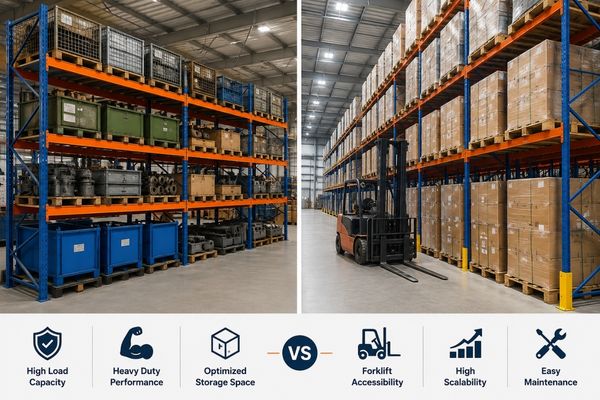
Heavy duty racks for warehouse operations are available in several configurations, but two terms often create confusion: heavy duty storage racks and heavy duty pallet racking systems. Both are designed for demanding industrial use, yet they can differ significantly in loading method, bay configuration, accessibility and material-handling requirements.
The right choice should be based on how goods arrive, how they are stored and how workers retrieve them. This buyer guide compares both systems so warehouse managers can prepare accurate requirements before approaching manufacturers or pallet racking suppliers.
What Is a Heavy Duty Rack System?
An industrial heavy duty rack is a robust steel storage structure designed for heavy cartons, components, tools, dies, raw materials or finished goods. Depending on the design, items may be placed manually, by trolley or with suitable handling equipment. Shelf or beam levels can often be adjusted to match changing product heights.
The heavy duty racking system offered by AE Storage Solution can be customized around available space, stored material and load requirements. Buyers should always request written load ratings for the proposed configuration.
What Is a Heavy Duty Pallet Rack System?
A heavy duty pallet rack system stores goods on pallets supported by horizontal beams connected to upright frames. Pallets are generally loaded and retrieved with a forklift or stacker. Systems may be arranged as single rows, back-to-back rows or other configurations based on access and storage-density requirements.
Explore the heavy duty pallet rack product page for a closer view of its components, applications and advantages. For operations requiring direct access to every pallet, selective pallet racks are often evaluated as part of the design process.
Heavy Duty Racks vs Pallet Racking: Key Differences
| Buying Factor | Heavy Duty Storage Rack | Heavy Duty Pallet Rack |
|---|---|---|
| Typical Unit Stored | Loose items, cartons, tools, components or bins | Palletized goods |
| Loading Method | Manual or equipment-assisted | Forklift or stacker |
| Access | Direct access to shelf contents | Access to pallet positions |
| Best For | Factories, workshops, stores and component warehouses | Warehouses, distribution centres and bulk pallet storage |
| Layout Driver | Item dimensions, picking height and shelf load | Pallet size, pallet weight, forklift and aisle width |
| Common Decking | Steel panels, suitable boards or custom supports | Pallets supported on beams; decking may be added when engineered |
Main Components of a Heavy Duty Pallet Racking System
- Upright frames that carry vertical loads and provide connection slots for beams.
- Horizontal beams sized according to span, pallet arrangement and approved load.
- Beam connectors and safety locking devices that secure beam positions.
- Base plates and anchors selected for the rack and supporting floor.
- Row spacers, pallet supports, backstops or decking where required by the design.
- Column guards, end protection and load notices appropriate to the operating environment.
How Load Capacity Should Be Evaluated
Load capacity should never be selected from a generic label. A rack may be described as heavy duty, but the approved capacity still depends on frame height, beam length, number and position of levels, steel section, connection design, anchoring and load distribution. The floor must also be suitable for the concentrated reactions created at the uprights.
Provide the maximum realistic weight, including the pallet or container, and identify uneven or concentrated loads. Ask the manufacturer to state capacity per level, per bay and for the complete proposed configuration. If rack levels are changed later, obtain approval before returning the system to service.
Which System Fits Your Warehouse?
Choose Heavy Duty Storage Racks When
- Workers pick individual cartons, tools, dies or components directly from shelves.
- Inventory is not consistently palletized.
- Shelf-level visibility and manual access are more important than pallet density.
- The system must accommodate products with different shapes or packaging.
Choose Heavy Duty Pallet Racks When
- Goods arrive, remain and leave on pallets.
- Forklift or stacker handling is already part of the operation.
- The warehouse needs organized pallet locations across multiple levels.
- Inventory records are managed by pallet position or batch.
Cost Factors for Heavy Duty Racks in India
The final price is influenced by steel quantity, frame height, beam span, number of levels, load rating, decking, finish, safety accessories, freight and installation. A low per-bay quotation is difficult to compare unless every supplier has priced the same dimensions, capacities and scope.
- Compare approved loads and steel sections, not only the overall rack size.
- Confirm whether freight, unloading, installation, anchoring and taxes are included.
- Ask whether column protection, load signs and other safety items are part of the quotation.
- Review drawing revisions and quantities before approving fabrication.
Heavy Duty Racks for Gujarat’s Industrial Locations
Businesses searching for heavy duty racks in Surendranagar, Nadiad, Mandal Bechraji or Himatnagar should prepare the same project information before requesting a quote: site dimensions, stored-item details, maximum loads, access equipment and delivery location. A manufacturer based near Ahmedabad can then evaluate design, transport and installation scope accurately rather than providing a generic price.
For a useful local enquiry, attach a warehouse sketch and photographs showing columns, doors, clear height and floor condition. Mention whether the requirement is for manual heavy duty racks, pallet racking, two-tier storage or a combination.
Questions to Ask Pallet Racking Suppliers
- Will you provide a layout drawing showing row lengths, aisles and storage positions?
- Are load ratings stated for the exact beam and frame configuration quoted?
- Which safety accessories, anchors and protection items are included?
- Is installation included, and who will inspect the completed system?
- What information is needed before rack levels or layouts are modified?
- Are replacement components and after-sales support available?
A Practical Buying Decision
Choose according to the load unit and handling process. If workers pick loose products or cartons, a heavy duty shelf-based system may provide better access. If the operation moves palletized loads by forklift, heavy duty pallet racking is usually the more appropriate starting point. Many warehouses use both systems in separate zones.
Frequently Asked Questions (FAQs)
A heavy duty rack may store loose goods, cartons, bins or industrial components on shelves or beams. A pallet rack is specifically configured to support palletized loads that are usually handled by a forklift or stacker.
Yes. Rack height, depth, beam span, number of levels, decking and accessories can be designed around the stored material and available space, subject to engineering and manufacturing limits.
Pallet weight, beam span, frame height, level spacing, steel section, connections, anchoring, floor condition and load distribution all affect the approved capacity.
They can be suitable when a small warehouse handles palletized goods and has appropriate lifting equipment. The layout must still provide safe aisles, access and building clearances.
Some lower levels may be designed for manual picking, often with suitable decking. This must be included in the original design because shelf support and load distribution differ from standard pallet storage.
Powder-coated steel is common, while other protective finishes may be considered for humidity, corrosion or special environments. The appropriate finish depends on site conditions.
Compare dimensions, steel sections, load ratings, quantities, accessories, finish, freight, installation, anchors, taxes, warranty terms and exclusions on a like-for-like basis.
Do not improvise repairs. Isolate the affected area and obtain an assessment from a competent person or the manufacturer. Replacement is often required when a component is deformed or structurally compromised.
Plan Your Warehouse Storage System with AE Storage Solution
A clear requirement and engineered layout will help you compare heavy duty rack and pallet rack proposals on safety, usability and total scope rather than price alone. Discuss your storage requirement with AE Storage Solution or use the contact page to request a site-specific recommendation and quotation.