Running a smooth and profitable warehouse starts with good organization. When you use the correct industrial storage equipment, everything changes. You can store more goods in the same space, your workers can find items faster, and inventory management becomes much easier.
Most importantly, the right storage setup improves workplace safety and boosts daily productivity. This guide will help warehouse owners, factory managers, and procurement teams understand the different types of storage systems and choose the best one for their daily operations.
What Is Industrial Storage Equipment?
Industrial storage equipment refers to the heavy-duty racks, shelves, bins, and platforms used to store goods in factories and warehouses.
Unlike household shelves or office cabinets, this equipment is engineered from high-grade steel to hold massive weights. It is built to survive tough industrial environments, resist damage from forklifts, and safely store everything from tiny nuts and bolts to giant steel pipes.
Why Industrial Storage Equipment Is Important
Investing in professional material storage equipment brings many benefits to your business:
- Space optimization: It uses your building’s vertical height, clearing up floor space.
- Product protection: Keeps fragile or expensive goods safely off the ground.
- Better organization: Every product has a specific home, making picking easy.
- Faster material movement: Forklifts and workers can move in and out of aisles quickly.
- Workplace safety: Strong, engineered racks prevent dangerous collapses and falling items.
- Inventory visibility: Helps managers see exactly what is in stock at a glance.
- Business scalability: Good systems can be expanded as your business grows.
Main Types of Industrial Storage Equipment
There are many types of industrial storage equipment, and each one solves a different problem. Let’s look at the top options for your facility.
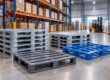
Pallet racking is the most common type of warehouse storage equipment. It is designed to store wooden or plastic pallets in horizontal rows with multiple levels.
- Applications: General warehouses, food distribution, and retail storage.
- Advantages: Gives direct access to every single pallet. It is very flexible and widely used.
- Limitations: Requires wide aisles for forklifts to turn safely, which can eat up floor space.
These are built with thicker, stronger steel to handle extreme weights that standard pallet racks cannot hold.
- Applications: Storing heavy machinery, metal dies, car engines, and large steel parts.
- Advantages: Incredible strength and durability. Very safe for heavy industrial goods.
- Limitations: Higher cost due to the amount of thick steel used. Not needed for lightweight goods.
Long-span shelving is ideal for medium-duty goods that are loaded and picked by hand, without a forklift.
- Applications: Auto parts, retail stockrooms, and archive box storage.
- Advantages: Very easy to adjust shelf heights. Great for oddly shaped cartons.
- Limitations: Not suitable for heavy forklift pallets.
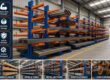
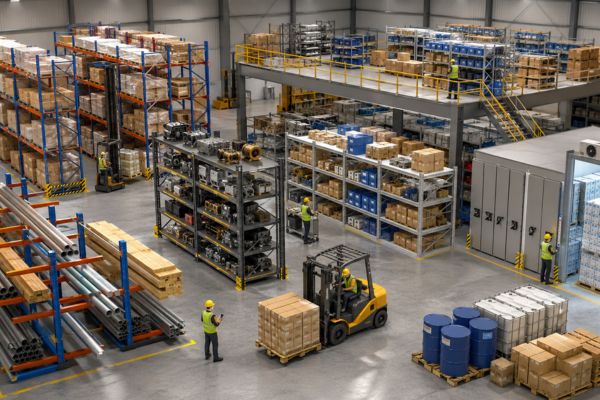
Cantilever racks have strong horizontal arms attached to a single back column. They do not have front columns, leaving the front wide open.
- Applications: Perfect for storing long materials like pipes, steel bars, timber, and metal sheets.
- Advantages: Easy to load long items since there are no vertical barriers in the way.
- Limitations: Mostly limited to storing long or bulky goods; not ideal for standard square pallets.
This system uses industrial racks and shelving to create multiple levels of walking aisles. It essentially builds a shelving system two or three stories high.
- Applications: E-commerce fulfillment and spare parts storage.
- Advantages: Maximizes vertical warehouse space without needing to build a concrete floor.
- Limitations: Only suitable for hand-picking items. Forklifts cannot drive on the upper levels.
A mezzanine is a raised steel platform that creates an entirely new working or storage floor above your main floor.
- Applications: Adding extra office space, packing areas, or bulk storage zones.
- Advantages: Doubles your usable floor space without the cost of moving to a new building.
- Limitations: Requires a high warehouse ceiling to be practical.
Mobile Storage Racks
Mobile racks are standard storage racks mounted on heavy-duty wheels and steel floor tracks. The racks pack tightly together, and you open a single aisle only when you need to access it.
- Applications: Cold storage rooms, high-density archives, and expensive real estate areas.
- Advantages: Stores a massive amount of goods in a very small space.
- Limitations: Access is slower because you must wait for the racks to roll open.
Rack-Supported Floor Systems
In this setup, the storage rack itself acts as the structural support for a raised walkway or even the building’s roof.
- Applications: Large-scale automated warehouses and major distribution centers.
- Advantages: Very cost-effective for large buildings since the rack and structure are built together.
- Limitations: Very difficult to change the layout once it is built.
Industrial Bins and Containers
Bins, crates, and containers sit on shelves or racks to hold loose items.
- Applications: Storing small items like screws, electrical components, and plumbing fittings.
- Advantages: Keeps tiny parts perfectly organized and prevents them from getting lost.
- Limitations: Only meant for small, lightweight materials.
Material Handling Equipment
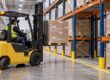
You cannot use racks without the right machines to move the goods. Material handling and storage equipment go hand in hand.
- Applications: Moving goods around the warehouse.
- Equipment Types: Pallet trucks (hand jacks), stackers, reach trucks, and lifting equipment.
- Advantages: Makes loading and unloading heavy items fast and safe for workers.
Industrial Storage Equipment Comparison Table
| Equipment Type | Best Used For | Load Category | Space Requirement | Main Benefit |
|---|---|---|---|---|
| Pallet Racking | Standard pallets | Medium to Heavy | High (needs aisles) | Easy access to all goods |
| Heavy-Duty Racks | Machinery, dies | Extra Heavy | Medium | Maximum strength |
| Long-Span Shelving | Hand-picked boxes | Medium | Low | Highly adjustable |
| Cantilever Racks | Pipes, timber, sheets | Heavy | Medium | No front column blocks |
| Multi-Tier Racks | Small parts, bins | Light to Medium | Low (uses height) | Maximum vertical space |
| Mobile Racks | High-density stock | Heavy | Very Low | Saves aisle floor space |
Applications of Industrial Storage Equipment by Industry
Different industries require different warehouse storage solutions:
- Automotive: Uses heavy-duty racks for engines and multi-tier shelving for small spare parts.
- Engineering: Relies on cantilever racks for steel bars and heavy-duty racks for machine tools.
- Pharmaceutical: Needs clean, easily accessible shelving and mobile racks for climate-controlled storage.
- Food and Beverage: Uses standard pallet racking for fast movement of perishable goods.
- Textile: Long-span shelving is used to store large rolls of fabric safely.
- Logistics: General pallet racking is used to handle mixed, varying loads every day.
- E-commerce: Multi-tier systems organize thousands of small, individual products for quick packing.
- Electronics: Static-free bins and secure shelving protect delicate tech components.
- Metal Processing: Uses cantilever racks for metal sheets and heavy-duty frames for steel coils.
- Construction Materials: Stores heavy bags of cement on pallet racks and lumber on cantilever racks.
How to Select the Right Industrial Storage Equipment
Choosing the right industrial warehouse equipment requires careful thought. Always consider these factors:
- Product type: Are your items in boxes, on pallets, or loose?
- Product weight: Choose a system engineered to handle your exact maximum load.
- Available floor space: Mobile or multi-tier racks are best if space is tight.
- Warehouse height: High ceilings allow for mezzanines and tall pallet racks.
- Loading and unloading method: Hand-picking needs shelves; forklift picking needs racks.
- Stock rotation: Do you need First-In, First-Out (FIFO) for items that expire?
- Accessibility: Do you need to reach every single item instantly, or can they be stored deeply?
- Budget: Balance the upfront cost against the long-term space savings.
- Expansion plans: Choose modular systems you can add to easily later.
- Safety requirements: Ensure the system includes column guards and meets local safety codes.
Static Storage Equipment Versus Mobile Storage Equipment
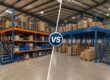
If you are debating between standard stationary racks and mobile racks, this table will help:
| Feature | Static Storage Equipment | Mobile Storage Equipment |
|---|---|---|
| Floor Space Used | High (many empty aisles) | Low (only one open aisle) |
| Picking Speed | Fast (all aisles open at once) | Slower (wait for aisle to open) |
| Upfront Cost | Lower | Higher (due to motors and tracks) |
| Best Application | Fast-moving goods (food, retail) | Slow-moving goods (archives, cold rooms) |
Common Mistakes When Selecting Warehouse Storage Equipment
Avoid these costly errors when buying warehouse equipment:
- Choosing only by price: Cheap racks are often made of thin steel that easily bends and collapses.
- Ignoring load requirements: Guessing weights leads to overloaded, unsafe racks.
- Poor space planning: Not leaving enough room for forklifts to turn causes daily accidents.
- Lack of future expansion: Buying a rigid system that cannot grow with your business.
- Incorrect aisle width: Making aisles too narrow to save space, trapping your machines.
- Ignoring maintenance: Forgetting that racks need regular safety checks.
- Buying incompatible components: Mixing rack brands can ruin the structural strength of the system.
Benefits of Customized Industrial Storage Systems
Sometimes, standard racks do not fit your specific needs. Industrial storage systems can be fully customized. Customization helps you fit racks around building columns, adjust beam heights perfectly to your products, and design special supports for odd-shaped items. A custom system maximizes your exact floor plan, improves worker workflow, and ensures zero wasted space.
Maintenance and Safety Tips for Storage Equipment
To keep your storage equipment safe and long-lasting, follow these tips:
- Never exceed the stated weight capacity of the racks.
- Train forklift drivers to drive carefully and avoid hitting the columns.
- Install steel column guards at the base of the racks for impact protection.
- Perform weekly visual checks for bent beams, missing safety pins, or floor damage.
- Call a professional to inspect the racks officially once a year.
- Fix or replace damaged parts immediately—never ignore a bent column.
Conclusion
The success of your warehouse depends entirely on how well you organize it. By understanding the different types of industrial storage equipment, you can choose the perfect solution for your space, load, and daily workflow. Whether you need cantilever racks for pipes or heavy-duty racking for pallets, the right choice will speed up your operations and keep your workers safe.
Are you ready to upgrade your warehouse with the best storage equipment? Contact our team today for a custom storage solution designed for your business!
Frequently Asked Questions (FAQs)
It refers to heavy-duty racks, shelving, and containers used in warehouses and factories to safely store large amounts of goods, raw materials, and finished products.
The main types include pallet racking, heavy-duty shelving, cantilever racks, multi-tier systems, mezzanines, and mobile storage racks.
Heavy-duty storage racks and structural pallet racking are the best options for extremely heavy items like machinery, metal dies, and large pallets.
Cantilever racks are the best choice for long materials like timber, pipes, and metal sheets because they do not have vertical columns in the front to block loading.
Shelving is generally used for medium or light-duty goods picked by hand. Pallet racking is designed to hold heavy wooden pallets moved by forklifts.
It allows you to build upward, utilizing the vertical height of your building. Systems like mobile racks also reduce the number of empty aisles, saving floor space.
Yes. Storage systems can be custom-engineered to fit your exact building dimensions, product weights, and specialized workflow requirements.
Multi-tier shelving systems, paired with industrial plastic bins and containers, are perfect for organizing and storing small parts safely.
Keep forklifts from hitting the racks, never overload the shelves, do daily visual checks for damage, and schedule a professional safety inspection annually.
Always check your product weight, available floor space, ceiling height, forklift turning radius, and whether you need quick access to every single item.