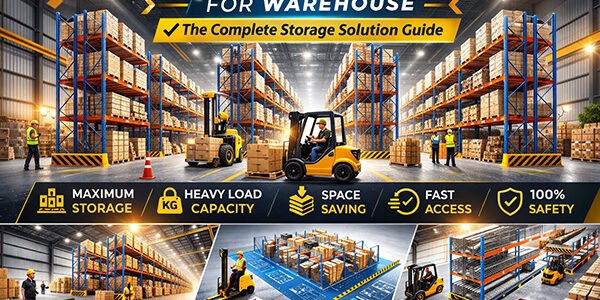
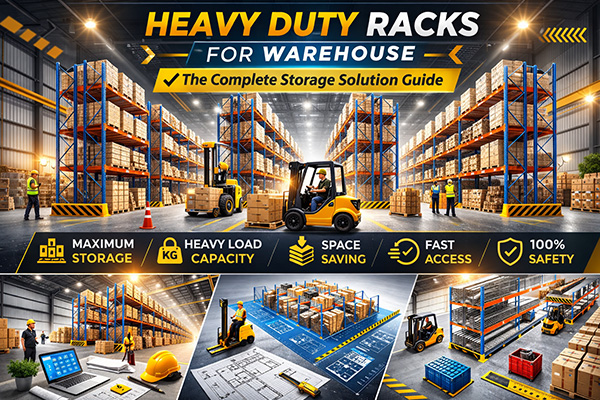
Managing a large inventory is one of the biggest challenges for any growing business. When your floor space is covered in boxes and pallets, movement becomes slow and accidents are more likely to happen. Installing Heavy Duty Racks for Warehouse storage is the most effective way to solve these problems. These systems allow you to use your vertical space, meaning you can store more goods in the same square footage while keeping everything organized and accessible.
Without a strong racking system, your warehouse is just a large room full of clutter. High-quality industrial racks are built to handle thousands of kilograms, ensuring that your expensive inventory and your hardworking staff remain safe. Whether you are running a small factory or a massive logistics hub, choosing the right heavy-duty storage solution is the first step toward a more profitable and efficient operation.
What are Heavy Duty Racks for Warehouse?
In simple terms, Heavy Duty Racks for Warehouse are high-strength metal frames designed to hold heavy goods vertically. Unlike standard office shelving, these are made from heavy-gauge steel. They are built to support massive weights, such as steel coils, large machinery parts, or full pallets of consumer goods.
Think of them like a multi-story parking garage for your products. Instead of leaving items on the floor, you “park” them on different levels using a forklift. This keeps the ground clear for workers and machines to move freely.
Benefits of Using Heavy Duty Racks for Warehouse Storage
Investing in a professional Warehouse Racking System offers several immediate advantages:
Space Optimization
Enhanced Safety
Superior Load Handling
Easy Inventory Management
Increased Productivity
Scalability & Future Expansion
Types of Heavy Duty Racks for Warehouse
Not every warehouse has the same needs. Here are the most common types of Industrial Storage Racks:
1. Pallet Racking (Selective)
This is the most popular type. It allows direct access to every single pallet. It is perfect for businesses that have many different types of products (SKUs).
2. Drive-In Racking
Designed for high-density storage. Forklifts drive inside the rack lanes to deposit pallets. This is great for storing large quantities of the same item.
3. Cantilever Racks
These have long arms sticking out from a central column. They are the best choice for long or bulky items like pipes, timber, or metal sheets.
4. Mezzanine Racks
This creates a second floor within your warehouse. You can use the top for an office or more storage while keeping the bottom area open for operations.
5. Long Span Shelving
Smaller than pallet racks but stronger than retail shelves. These are ideal for heavy boxes that are loaded by hand rather than by forklift.
Comparison Table: Which Rack Suits You?
| Rack Type | Best Used For | Access Speed | Space Efficiency |
|---|---|---|---|
| Selective Pallet | General goods, many SKUs | ⚡ Very Fast | Medium |
| Drive-In | High volume, same product | ⏳ Slow | 🔥 Very High |
| Cantilever | Pipes, Lumber, Steel Bars | ⚡ Fast | High (for long items) |
| Long Span | Hand-picked heavy boxes | ⚡ Fast | Medium |
How to Choose the Right Heavy Duty Racks for Warehouse
Heavy Duty Rack Load Capacity Explained
Understanding load capacity is vital for safety. Capacity is usually measured “per pair of beams.”
Example: If a rack level is rated for 2,000kg, and you have two pallets weighing 1,200kg each, you are overloading the rack.
Calculation Tip: Total Weight of Pallets < Rated Beam Capacity.
Always look for the “Load Sign” on the end of the rack aisles to know the limits.
Industries Using Heavy Duty Racks for Warehouse
Many sectors rely on these systems to keep their supply chains moving:
Manufacturing
Pharmaceuticals
Textiles
FMCG & Logistics
E-commerce
Common Warehouse Storage Problems Solved
| 🚧 Warehouse Problem | ✅ Solution with Heavy Duty Racks |
|---|---|
| ❌ No Floor Space | ⬆️ Use vertical storage to maximize warehouse height and free valuable production space. |
| ❌ Damaged Goods | 📦 Structured racking eliminates unsafe stacking and protects products from crushing damage. |
| ❌ Slow Picking | ⚡ Organized rack layout supports efficient First-In, First-Out (FIFO) inventory movement. |
| ❌ Worker Injuries | 🦺 Proper racks prevent falling materials and create safe walking & forklift pathways. |
Safety Guidelines for Heavy Duty Warehouse Racking Systems
Safety should always come first in an industrial environment. Use this checklist:
Regular Inspections
Floor Anchoring
Load Labels
Column Protectors
No Climbing
Why Choose a Professional Warehouse Rack Manufacturer?
While it might be tempting to buy cheap, unbranded racks, working with an experienced Warehouse Rack Manufacturer ensures quality. Professionals provide:
1.Custom Design:
Racks tailored to your specific building dimensions.
2.High-Grade Material:
Certified steel that won’t bend under pressure.
3.Expert Installation:
Ensuring the system is perfectly level and safe.
4.Warranty & Support:
Long-term peace of mind for your investment.
Frequently Asked Questions (FAQ)
1. What is the standard height for Heavy Duty Racks for Warehouse?
Standard heights usually range from 10 feet to 30 feet, depending on your ceiling height and forklift reach.
2. How much weight can a heavy-duty pallet rack hold?
Most heavy-duty levels are designed to hold between 1,000kg and 4,000kg per pair of beams.
3. Do I need to bolt the racks to the floor?
Yes. For safety and stability, all industrial racking must be anchored to a solid concrete floor.
4. What is the difference between Pallet Racking and Shelving?
Racking is for heavy, palletized goods handled by machines. Shelving is for lighter items picked by hand.
5. How often should I inspect my warehouse racks?
A basic visual check should be done weekly, with a detailed professional inspection once a year.
6. Can I move my racks if I relocate my warehouse?
Yes, most heavy-duty systems are modular and can be dismantled and reinstalled at a new location.
7. How wide should the aisles be?
Standard aisles are usually 10-12 feet, but “Narrow Aisle” systems can be as small as 5-6 feet.
8. What is “Beam Deflection”?
This is the slight bending of a beam under weight. A small amount is normal, but it should never exceed 1/180th of the beam’s length.
Conclusion
Choosing the right Heavy Duty Racks for Warehouse use is more than just buying furniture; it is an investment in your company’s future. By maximizing your space, you reduce costs. By improving organization, you increase speed. Most importantly, a high-quality racking system keeps your employees safe and your inventory protected.