storage-racks-packaging-industry-ahmedabad

In a packaging manufacturing facility, material flows in a clear sequence — raw material arrives, gets processed into work-in-progress, becomes finished goods, and leaves as dispatch. The trouble starts when this flow is disrupted by storage chaos.

Rolls of BOPP film stacked on the floor waiting to be loaded. Corrugated sheets bending because they have no vertical support. Finished carton bundles mixed with rejected stock. Ink and adhesive drums blocking the pathway between press and lamination machines.

Every one of these storage failures slows your production line, creates quality risks, and wastes expensive material.

At Advance Engineering, we design storage rack systems for packaging facilities that are built around your production flow — not generic warehouse logic. We look at where material enters, how it moves through your plant, where work-in-progress accumulates, and where finished goods wait for dispatch — then we design a rack solution for each zone.

This is how your packaging facility becomes lean, fast, and organized.

Understanding the Packaging Industry’s Storage Journey

A packaging plant is not a warehouse. It is a factory where materials are constantly in motion through multiple stages. Rack placement must follow production flow — not just fill available floor space.

Here is a typical packaging production flow and the storage needs at each stage:

Stage 1 — Raw Material Inward and Storage

What arrives: Film rolls (BOPP, PET, LDPE, CPP), corrugated sheets and boards, kraft paper rolls, aluminum foil, ink drums, adhesive tubs, metal clips, and plastic handles.

Storage challenge: Raw materials in a packaging plant come in cylinders, rolls, sheets, and drums. No single rack type handles all of these.

Our solution for each material type:

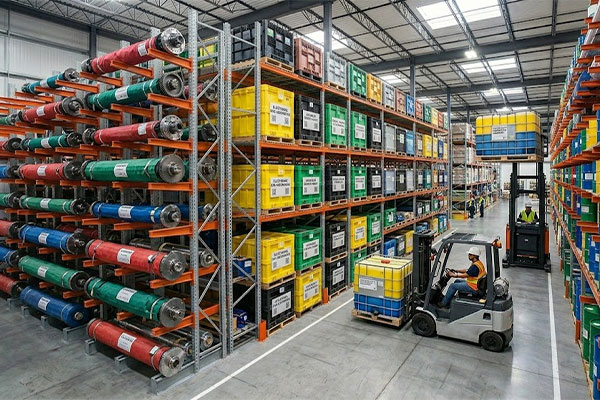
  • Film rolls and paper rolls → Cantilever racks or A-frame roll stands with horizontal arms
  • Corrugated sheets → Vertical slot racks that keep sheets upright without bending
  • Ink and adhesive drums → Heavy duty pallet racks or drum storage cradles
  • Small packaging accessories → Slotted angle racks with bin boxes

Stage 2 — Production Floor Material Feeding

What moves here: Sub-quantities of raw material from main storage to machine line-side.

Storage challenge: Machine operators need quick, frequent access to film rolls, ink sets, and tooling between job changes. They cannot walk to the main warehouse for every replenishment.

Our solution: Line-side shadow board trolleys and small cantilever units next to each machine station, holding one job run’s worth of material. Replenished daily from main storage.

Stage 3 — Work in Progress (WIP) Holding

What is stored here: Semi-finished packages waiting for the next processing stage — laminates waiting for printing, printed film waiting for slitting, pre-formed cartons waiting for gluing.

Storage challenge: WIP is time-sensitive (it should not sit long), varied in size, and often fragile (fresh laminates can block-stick if stacked incorrectly).

Our solution: Designated WIP racks at fixed station points between machines. These are typically short-height (1.5–2.0 m) long-span shelving units positioned between process stations on the plant floor — not in a separate storage room. WIP that is visible and accessible is WIP that moves.

Stage 4 — Finished Goods Storage Before Dispatch

What is stored here: Counted and inspected carton bundles, roll sets, label reels, and packaged finished goods waiting for customer pickup or outward transport.

Storage challenge: Finished goods need to be organized by customer, job number, or dispatch date — not just stacked wherever there is space. Incorrect dispatch is among the most expensive errors in packaging.

Our solution: Heavy duty pallet racking with dedicated bay-level positions labeled by customer or job. FIFO is enforced through a simple physical flow — new goods enter from the back, dispatch happens from the front.

Rack Types We Build for Packaging Industry Facilities

Cantilever Racks — For Film Rolls, Paper Rolls, and Long Material

The most important rack type in any packaging facility. Cantilever racks support rolls and long materials horizontally without floor-contact damage. We build these in single-sided (wall-mounted) and double-sided versions with adjustable arm heights.

Roll diameters from 300 mm to 1,200 mm are accommodated with appropriate arm spacing. Maximum roll weight up to 1,200 kg per arm pair.

Vertical Sheet Racks — For Corrugated Boards and Flat Material

Corrugated sheets, rigid boards, and flat packaging blanks must be stored vertically, like books on a shelf. Horizontal stacking causes bowing, crushing, and moisture absorption from the floor.

Our vertical sheet storage racks create 200–400 mm wide slots with bottom rails that support the sheet edge. Each slot can hold a stack of sheets organized by size, grade, or customer.

Long Span Shelving — For Mid-Weight Packaging Materials and WIP

The most versatile rack in a packaging plant. Long span shelving with adjustable beams handles everything from laminate rolls on upper levels to carton bundles on lower levels. Our packaging-configured long span shelving features:

  • Bay widths of 1,500–2,400 mm
  • Beam heights adjustable in 50 mm increments
  • Optional chipboard, steel mesh, or wire mesh decking
  • Capacity from 400 kg to 1,200 kg per level

Heavy Duty Pallet Racks & Drum Cradle Storage

Heavy Duty Pallet Racks — For Finished Goods and Drum Storage
For finished goods dispatch areas and drum/tub storage of inks, adhesives, and coating materials, heavy duty pallet racks offer the highest density storage with fork-lift compatibility. Our packaging-grade pallet racks use slotted uprights for maximum beam position flexibility.

Drum Cradle Storage — For Ink and Chemical Safety
Drums of printing ink, solvent, and adhesive need specialized storage that prevents rolling, keeps them at the correct tilt angle for dispensing, and contains spills. We supply drum cradle racks and spill containment platforms specifically for packaging chemical storage.

How Our Rack Design Helps Reduce Waste in Packaging Operations

In a packaging plant, storage inefficiency directly causes material waste:

  • Film rolls stored on the floor get edge damage → waste during slitting and printing
  • Corrugated sheets stored horizontally absorb moisture and warp → rejected at QC
  • Ink drums stored without rotation management → expired ink used, quality defects
  • Finished goods stored without order separation → wrong goods dispatched, returns

A well-designed rack system eliminates each of these waste sources by:

  • Keeping every material off the floor and in its designated position
  • Ensuring FIFO rotation through front-access, rear-load rack configurations
  • Creating clear physical separation between raw material batches and finished goods
  • Making every item visible at a glance, reducing the risk of missed expiry or wrong dispatch

Packaging Industry Projects Completed by Advance Engineering

We have installed storage rack systems for packaging companies across these segments:

  • Flexible packaging manufacturers (BOPP, PET, multilayer laminates)
  • Corrugated box manufacturers and converters
  • Rigid packaging (PET bottles, HDPE containers, glass bottles)
  • Label and self-adhesive products manufacturers
  • Paper bag and carry bag manufacturers
  • Metal packaging (tin can, aluminum closure) facilities
  • Contract packaging and co-packing warehouses

Frequently Asked Questions — Packaging Industry Storage Racks

Film rolls should be stored horizontally on cantilever arms or padded A-frame stands — never standing vertically on their edge (which causes oval deformation) and never stacked directly on the floor (which damages the outer wound layers). Cantilever arms with rubber or HDPE sleeve covers protect the core from metal contact. Keep rolls away from direct sunlight and heat sources to prevent film blocking.

Corrugated boards must be stored vertically in slot racks, never laid flat in stacks. When laid flat, the board weight compresses lower sheets, and humidity causes warping. Vertical slot storage keeps every sheet independent, supported on its edge, and free from compression damage. Our sheet slot racks are sized for standard corrugated sheet sizes but can be customized for your specific board dimensions.

Ink drums and solvent containers require specialized cradle storage with spill containment. We provide drum cradle frames that hold drums at a slight angle for easy dispensing, with a secondary containment tray that captures any accidental spills. For flammable inks and solvents, we specify grounded steel rack options to prevent static buildup — compliant with factory fire safety requirements.

Yes. Many packaging plants are long, narrow buildings with specific aisle constraints. We have designed rack systems for aisles as narrow as 900 mm for manual-pick zones and configured pallet racks for reach-truck-compatible 1,800 mm aisles where fork-lift access is needed. Every layout is drawn to your exact floor plan dimensions before manufacturing starts.

For packaging plants that frequently reorganize their production lines, we offer mobile shelving racks on castor wheels (with locking brakes) for WIP and line-side storage positions. For fixed storage areas, our modular rack systems can be disassembled, moved, and reassembled without special tools or replacement parts in most cases.

The calculation depends on your average inventory holding (in weight or volume), the size of your storage items, and your desired aisle configuration. As a rough estimate: one heavy duty pallet rack bay (3 levels × 2 pallet positions) holds approximately 6 standard pallets in 3.0 m × 1.5 m of floor space (including aisle). We prepare a detailed calculation for every project as part of our free layout design service — no guesswork needed.