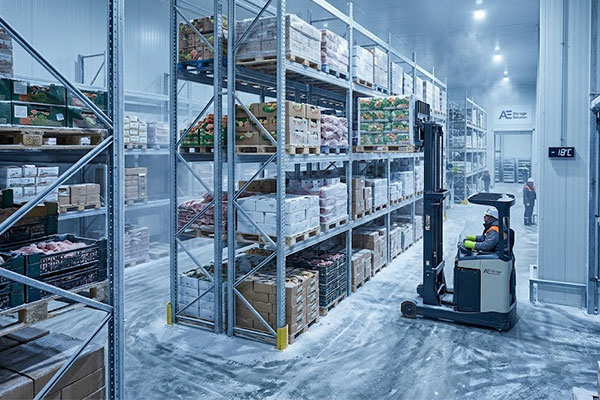
pallet-racking-cold-storage-warehouse-manufacturer-ahmedabad

Cold storage warehousing is one of the most technically demanding environments for any racking system. Temperatures ranging from +4°C (chiller) to -25°C (deep freeze) affect steel, coating, and joint integrity in ways that simply do not apply to ambient warehouses.

A rack designed for a normal warehouse will not perform the same inside a cold room. Steel becomes more brittle at low temperatures. Condensation from frequent temperature cycling causes corrosion at joints and base plates. Anti-corrosion coatings that work at room temperature may not bond correctly at cold room temperatures. Standard epoxy powder coats crack and peel in freeze-thaw cycles.

Getting cold storage racking wrong does not just waste money. A rack collapse inside a cold room is a catastrophic event — product loss, facility damage, potential injury, and regulatory consequences that can shut down your operation.

Advance Engineering specializes in designing and supplying pallet racking systems specifically for cold storage and refrigerated warehouse environments — with the right materials, right coatings, and right structural calculations for your specific temperature range.

Understanding Cold Storage Racking — Why It’s Different from Standard Pallet Racking

Before choosing a racking supplier for your cold room, it is critical to understand how a low-temperature environment changes the engineering requirements of the rack.

Effect of Low Temperature on Steel

Carbon steel (like standard IS 2062) becomes more brittle at sub-zero temperatures. While this is typically not an issue in normal cold rooms (-5°C to -25°C range for food storage), it becomes important when selecting section sizes — thicker sections have better cold-temperature toughness. Our cold storage racks use heavier section steel with a minimum thickness of 2.0 mm for all structural members, compared to 1.8 mm in our standard products.

Condensation and Corrosion in Cold Rooms

Cold rooms operate in a constant cycle of cold storage and warm air entry (when doors open). This creates condensation on rack surfaces — especially at the floor level where warm and cold air meet. Condensation accelerates rust at base plates, column feet, and any unpainted cut edges.

Our cold storage racks are designed with:

  • Hot-dip galvanized surface treatment for maximum corrosion resistance (instead of standard powder coat)
  • Full zinc coverage at cut edges and punched holes
  • Elevated base plates with stainless steel anchor bolts to prevent galvanic corrosion at floor contact
  • Smooth, rounded profile designs with no water-trapping horizontal ledges

FIFO and FEFO — Food Safety Requirements

Food stored in cold rooms operates under FIFO (First In, First Out) or FEFO (First Expired, First Out) protocols — required by FSSAI regulations and global food safety standards like HACCP and BRC. The racking system must physically support FIFO/FEFO access so that older stock always leaves before newer stock.

Dense Racking vs Fast Access — The Cold Room Trade-Off

In cold storage, every square foot of racking directly translates to refrigeration cost. More dense storage = more goods in the same refrigerated volume = lower energy cost per pallet position. But dense storage (like drive-in racks) has slower access than selective racks.

The right racking choice depends on how many SKUs you store, how fast they move, and whether you need FIFO or bulk-pick access.

Types of Pallet Racking for Cold Storage — Which is Right for Your Warehouse?

Selective Pallet Racking for Cold Storage

Best for: Multi-SKU cold storage warehouses where FIFO access to every pallet individually is required.

How it works: Standard front-access pallet racking where every pallet position is directly reachable by fork-lift from the main aisle. Full selectivity — any pallet can be retrieved without moving another.

Cold storage version differences:

  • Minimum frame size: 100 mm × 50 mm × 2.0 mm C-section uprights
  • Hot-dip galvanized finish throughout (not powder coat)
  • Beam safety locks rated for low-temperature operation
  • Wider fork-lift aisle allowance (standard cold room fork-lifts are larger with driver cabins)

Aisle width required: 2.7 m to 3.2 m depending on fork-lift type. Storage density: Moderate (one pallet deep per aisle side). FIFO compliance: Yes — every pallet is individually accessible.

Drive-In Pallet Racking for Cold Storage

Best for: Single-SKU or limited-SKU cold rooms where maximum density is the priority and LIFO (Last In, First Out) access is acceptable.

How it works: Fork-lift drives inside the rack to place and retrieve pallets. Pallets are stored 2–8 deep on rails. No aisle needed between rows — all aisles are eliminated except the entry aisle.

Cold storage version differences:

  • Extra-heavy rail profiles to handle fork-lift load over extended unsupported span
  • Drive-in guide rails at floor level for fork-lift alignment in low-visibility cold room
  • Column protectors at all entry points
  • Hot-dip galvanized frame throughout

Storage density: Very high — 70–85% more positions than selective racking in same floor area. FIFO compliance: No (LIFO access) — not suitable for perishable goods requiring FIFO.

Push-Back Pallet Racking for Cold Storage

Best for: Cold rooms with 2–5 SKUs per bay, needing LIFO access with better density than selective but more selectivity than drive-in.

How it works: Pallets are stored 2–5 deep on inclined rails with nested carts. When a pallet is placed, it pushes back the previous pallet. When retrieved, the remaining pallets slide forward automatically.

Cold storage version differences:

  • Stainless steel or galvanized cart components for corrosion resistance
  • Low-friction rail coating for reliable cart movement at cold temperatures
  • Minimum slope angle: 3° (steeper than ambient — cold room floor condensation reduces cart momentum)

Storage density: High — eliminates most aisles. FIFO compliance: No (LIFO) — best for products with longer shelf lives.

Gravity Flow Racking (Pallet Live Storage) for Cold Storage

Best for: Cold storage facilities where strict FIFO is mandatory — fresh produce, dairy, meat, pharmaceuticals — and where high throughput demands fast loading and unloading.

How it works: Pallets are loaded from the back of the rack on inclined roller tracks. Gravity moves them to the front. First-in pallet is always at the front for immediate picking. FIFO is guaranteed by physics — no procedure required.

Cold storage version differences:

  • Stainless steel rollers for corrosion resistance in high-humidity cold room environments
  • Load-limiting roller speed governor to prevent pallets from moving too fast
  • Minimum slope: 3–4% grade on roller track
  • Hot-dip galvanized frame structure

Storage density: High (up to 80% higher than selective in same area). FIFO compliance: Absolute — guaranteed by system design, not procedure.

Cold Storage Rack Specification Comparison Table

Feature Selective Drive-In Push-Back Gravity Flow
FIFO Access ✅ Full ❌ No (LIFO) ❌ No (LIFO) ✅ Automatic
Storage Density Medium Very High High High
SKU Flexibility Very High Low Medium Medium
Fork-lift Access Front only Drives inside Front only Front/Rear separated
Best Application Multi-SKU perishables Single SKU bulk 2–5 SKU per lane FIFO-critical perishables
Surface Finish Hot-dip galvanized Hot-dip galvanized Hot-dip galvanized Galvanized + SS rollers

Cold Storage Racking Installation — What We Do Differently

Installing racks in a cold room is physically harder than in an ambient warehouse. The installation team works in 0°C to -20°C environments. The floor may be uneven from insulation panel settlement. The insulated ceiling limits available height clearance. And the cold room cannot be left open for extended periods without affecting stored goods.

Our cold room installation process:

  • Pre-fabricate all rack components to exact dimensions at our Ahmedabad factory
  • Organize installation in shifts to minimize cold room door-open time
  • Use stainless steel anchor bolts and corrosion-resistant chemical anchors
  • Verify all plumb and level after anchoring — cold room PUF floors can be uneven
  • Apply zinc-rich cold-cure paint to any cut edges created during installation
  • Conduct a final load check and handover with full documentation

Cold Storage Industries We Serve

  • Fresh produce and vegetable cold chains (potato, onion, fruit)
  • Dairy product cold stores (milk, paneer, butter, cheese)
  • Meat and poultry processing cold rooms
  • Fish and seafood cold storage
  • Pharmaceutical cold chain warehouses (vaccines, biologicals, 2°C–8°C)
  • Ice cream and frozen desserts
  • Frozen food and ready-to-eat product cold chains
  • Hotel, hospital, and institutional cold kitchen storage

Frequently Asked Questions — Pallet Racking for Cold Storage

Standard pallet racks are typically surface-treated with epoxy powder coating, which can crack and peel in freeze-thaw cycles over time, leading to rust. The steel sections used in standard racks may be lighter gauge than what is recommended for sub-zero environments. Additionally, the base plate designs of standard racks are not optimized for the condensation and moisture conditions inside cold rooms. Cold storage racks with hot-dip galvanizing, heavier steel sections, and elevated base plates are significantly more durable and safer for long-term cold room use.

Our standard cold storage racks are designed for use in environments from -30°C to +40°C. This covers all standard cold room applications — fresh produce storage (+2°C to +8°C), blast chilling (-15°C to -20°C), and deep freeze (-25°C to -30°C). For ultra-low temperature applications below -30°C, please inform us during the inquiry stage so we can specify appropriate steel grades.

FIFO (First In, First Out) compliance is built into the rack type you choose. Gravity flow racks guarantee FIFO automatically — physics ensures the first pallet in is always the first out. Selective pallet racks also support FIFO when used with a disciplined putaway procedure (new pallets always go to the back of the row). Drive-in and push-back racks are LIFO by design and should not be used where strict FIFO is required for food safety. We discuss FIFO requirements with every cold storage client before recommending a rack type.

Installation in an operational cold room takes longer than in an ambient warehouse due to the need to minimize door-open time. A typical installation is done in 2–3-hour shifts per day. A 1,000 sq. ft. cold room racking project typically takes 4–6 days. Larger cold rooms of 5,000–10,000 sq. ft. are planned over 2–4 weeks. We always coordinate installation schedules with your cold room operations team to minimize disruption.

Yes. All cold room floors have a drainage slope of 0.5%–1.5%. Our base plates are designed to accommodate this using shim plates of up to 20 mm height under each base plate foot. Larger slopes may require custom base plate fabrication. The important point is that the rack columns must be plumb (perfectly vertical) even if the floor is sloped — this is what our installation team verifies during installation using precision levels.

Cold storage racks with hot-dip galvanized finish require minimal maintenance. We recommend a quarterly visual inspection of base plates (checking for rust staining which could indicate anchor bolt corrosion), beam safety locks (checking all locks are engaged), and column straightness (checking for any post-impact deformation). Annually, a formal rack inspection by a qualified person as per IS 15635 or equivalent standard is recommended. We offer a post-installation inspection service for clients who require formal certification.

Yes. Walk-in chiller racks for hotel kitchens, hospital central kitchens, and food service operations are a specialized product — smaller scale than industrial cold storage but requiring the same corrosion resistance. We supply stainless steel (SS 304) wire shelving racks for kitchen cold rooms, and mild steel galvanized racks for larger walk-in storage rooms. All finishes are food-safe and cleanable with standard food industry sanitizers.