Industrial Cantilever Racking Systems in India: Everything You Need to Know
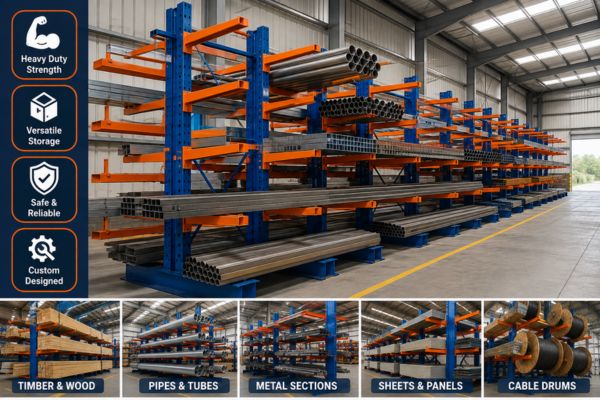
Long and bulky materials are difficult to store on conventional shelving. Pipes, steel bars, aluminium profiles, timber, panels and bundled components may extend beyond standard bays, while front uprights can obstruct loading. A heavy duty cantilever rack solves this problem with an open-front design supported by horizontal arms.
This guide explains how cantilever systems work, which design inputs affect capacity and what buyers should compare when selecting cantilever rack manufacturers in India.
What Is a Cantilever Rack?
A cantilever rack consists of vertical columns connected to a base and fitted with projecting arms. Loads rest across two or more arms, and the open front allows long products to be placed or removed without front posts interfering. Systems can be configured as single-sided racks against an access boundary or double-sided racks accessible from both sides.
The cantilever rack range from AE Storage Solution is intended for profiles, pipes, flat items such as steel plates and sheets, and other bulky construction or industrial components. Dimensions and arm profiles should be selected according to the actual material and available space.
Common Applications of Heavy Duty Cantilever Racks
- Steel pipes, tubes, bars, angles, channels and structural sections.
- Timber, plywood, laminates, boards and furniture components.
- Aluminium and uPVC profiles, conduits and extrusions.
- Sheet packs, panels, dies and long engineering components.
- Building materials and products with irregular lengths or shapes.
Single-Sided vs Double-Sided Cantilever Racks
| Design Factor | Single-Sided Rack | Double-Sided Rack |
|---|---|---|
| Access | Loading from one side | Loading from both sides |
| Typical Position | Along a wall or boundary with suitable clearance | Open warehouse or yard rows |
| Space Use | Uses perimeter space efficiently | Creates storage positions on both faces |
| Material Flow | Suitable for one-direction access | Supports access from parallel aisles |
| Design Requirement | Base and column designed for one-sided loading | Structure designed for loading on both faces |
Main Components of a Cantilever Rack
Columns
Columns carry loads from the arms and transfer them through the base to the supporting floor. Column height, section and bracing depend on the required storage levels and approved capacity.
Bases
The base provides stability and supports the lower part of the structure. Its length and anchoring arrangement must suit the cantilever geometry and loading direction.
Cantilever Arms
Arms support the stored material. Arm length, spacing, inclination, end stops and connection design must suit the product dimensions and loading method. Loads should not extend beyond the approved support arrangement in a way that creates instability.
Bracing and Connections
Horizontal or diagonal bracing maintains row alignment and transfers forces between columns. Connections, anchors and locking arrangements should remain accessible for inspection.
How to Determine the Correct Rack Design
- List the minimum and maximum product lengths, widths, heights and bundle sizes.
- Confirm the maximum bundle or item weight, including packaging and supports.
- Decide how many storage levels and product groups are required.
- Identify the handling method: forklift, side loader, crane or manual handling.
- Measure available clear height, row length, aisle width and floor condition.
- Define whether access is required from one side or both sides.
Arm Spacing and Load Distribution
The load must be supported by enough arms to prevent excessive bending, sagging or local concentration. Long, flexible materials may need closer supports than rigid bundles. Unevenly distributed or point loads must be identified because they can place more force on one arm or column than a uniformly distributed load of the same total weight.
Ask the manufacturer to show the approved load per arm, per level and per column or rack side for the exact configuration. Do not assume that every arm position has the same capacity after changing arm lengths, levels or column height.
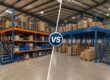
A rack supported floor may involve a broader deck area and different structural demands, while a two-tier rack may concentrate investment around shelf locations and picking walkways. The lowest initial price is not always the lowest operational cost if the layout creates long travel routes or difficult replenishment.
Cantilever Rack Layout and Handling Access
The open front improves access, but aisles still need to match the handling equipment and longest product. The required turning envelope may be much larger for long bundles than for standard pallets. Door widths, roof columns, cranes, outdoor drainage and adjacent work areas can also affect the row position.
- Keep products within the approved arm and rack envelope.
- Separate pedestrian areas from active loading aisles where practical.
- Protect columns and rack ends exposed to vehicle impact.
- Use suitable end stops when required to reduce the risk of materials rolling or sliding.
- Maintain clear visibility of load notices and rack condition.
Cantilever Racks vs Pallet Racks
Cantilever racks are designed for long or irregular products that need unobstructed front access. Pallet racks use upright frames and beams to create pallet positions and are better suited to standardized palletized goods. A warehouse handling both product types may use cantilever rows for long materials and heavy duty pallet racks for boxed or palletized stock.
Price Factors for Heavy Duty Cantilever Racks
- Single-sided or double-sided configuration.
- Column height, row length and number of bays.
- Arm length, number of levels and approved load per arm.
- Steel sections, bracing, base design and anchors.
- Indoor or outdoor finish and environmental exposure.
- End stops, protection, freight, unloading and installation scope.
Request a quotation based on a drawing and load schedule. Comparing only price per bay can be misleading when suppliers have assumed different arm capacities, column heights or accessories.
How to Compare Cantilever Rack Manufacturers in India
- Share accurate product dimensions and weights rather than asking for a generic heavy duty rack.
- Request a layout and elevation showing arm levels, aisle access and overall dimensions.
- Confirm load ratings for the exact arm, column and base configuration.
- Check the included finish, accessories, freight, installation and inspection scope.
- Ask how future arm-level adjustments or extensions should be reviewed.
- Confirm availability of replacement arms, connectors and after-sales support.
Build the Requirement Before Requesting a Quote
The most reliable quotation starts with a material schedule, warehouse measurements and handling method. When suppliers receive the same data, buyers can compare structural scope and usability on a like-for-like basis. A properly selected cantilever rack should make long materials easier to identify, load and retrieve while keeping them off the floor and within approved storage positions.
Frequently Asked Questions (FAQs)
Cantilever racks are commonly used for pipes, tubes, bars, timber, profiles, panels, sheet packs and other long, bulky or irregular materials.
It is a cantilever system engineered for demanding industrial loads using columns, bases, arms, bracing and anchors selected for the required material dimensions and weight.
Single-sided racks are loaded from one face, while double-sided racks provide storage arms and access on both faces. The supporting structure must be designed for the selected loading arrangement.
Capacity depends on arm length, steel section, connection, column configuration and load distribution. The manufacturer should provide an approved rating for the exact design.
Many systems allow adjustable arm positions, but any change must remain within the manufacturer’s approved configuration and load limits.
They may be designed for outdoor use with an appropriate finish and consideration of environmental conditions, foundations, drainage and site exposure. The manufacturer should review the actual location.
Anchoring is commonly part of the engineered system. Anchor type and arrangement depend on rack design and supporting floor or foundation conditions.
The quote should identify dimensions, bays, arms, load ratings, finish, bracing, bases, anchors, accessories, freight, installation, taxes and exclusions.
Plan Your Warehouse Storage System with AE Storage Solution
A cantilever rack should be selected from real product dimensions, weights and handling conditions, not from a generic capacity label. Discuss your storage requirement with Advance Engineers or use the contact page to request a site-specific recommendation and quotation.
Also compare the mezzanine floor option when the upper level must remain structurally independent from the storage racks or serve a use that is better suited to a freestanding platform.