storage-racks-electronics-industry-ahmedabad

In electronics manufacturing and warehousing, one thing is clear: damage during storage is just as costly as damage during production.

A static discharge from an ungrounded metal shelf can destroy a sensitive IC chip. A rack that vibrates near heavy machinery can cause delicate PCBs to develop micro-cracks invisible to the eye — but detectable as field failures months later. Crowded shelves with unlabeled bins mean time wasted locating components — and misidentification mistakes that go undetected until the product reaches the customer.

The electronics industry stores items that range from 2-gram resistors to 50-kilogram electrical panels. From a 5 mm component reel to a 2-metre UPS cabinet. Each requires a completely different storage approach.

Advance Engineering designs and manufactures storage racks for electronics and electrical equipment manufacturers, component distributors, PCB assembly houses, and consumer electronics warehouses — with specific attention to ESD safety, vibration control, component traceability, and clean storage environments.

What Makes Electronics Storage Different from Other Industries?

Most industries store goods by weight and size. Electronics storage must also consider:

Electrostatic Discharge (ESD) — The Invisible Enemy

Electronic components — semiconductors, ICs, transistors, FETs, op-amps — are sensitive to static electricity. A static charge of as little as 100V (well below what a human can feel) can permanently damage certain semiconductors. The source of that static is often a metal shelf that has not been grounded.

For electronics storage, the right approach is:

  • Anti-static coated or ESD-safe shelf surfaces
  • Grounding cables connecting rack frames to earth
  • ESD flooring or anti-static mats in the storage aisle
  • ESD bags and bins as additional protection at component level

Our electronics storage racks are available with anti-static powder coating and earth bonding provisions as a standard option.

Vibration Sensitivity

PCBs with SMD (Surface Mount Device) components can develop solder joint cracks if stored near sources of vibration — heavy presses, stamping machines, or even diesel generator sets. Rack legs with vibration-dampening pads should be used when the storage area is near vibration sources.

Component Traceability — Lot Numbers Matter

In electronics, a batch of components from the same supplier lot can have the same defect. Traceability requires that different batches of the same component are never mixed on the same shelf. Storage racks must support bin-level segregation with lot number labels on every position.

Dust and Environmental Control

Dust on PCBs and sensitive components causes insulation failure and leakage currents. Storage areas for electronics should have racks with minimal horizontal surfaces that collect dust, and optional closed cabinet doors for long-term storage of high-value components.

Storage Rack Types for the Electronics Industry

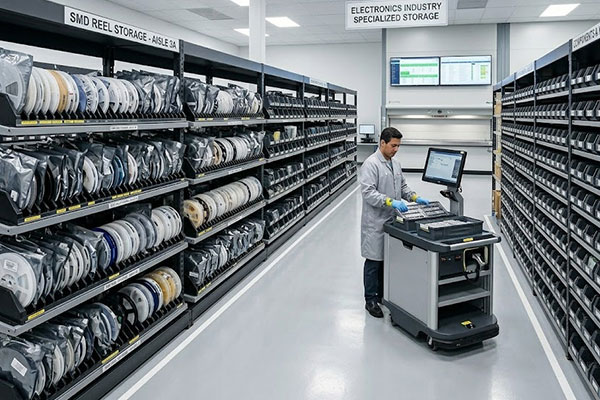
Component Storage Racks — For SMD Reels, ICs, Passives, and Connectors

Small electronic components represent the highest SKU count in any electronics facility — thousands of part numbers in tiny quantities. Organization here directly affects production line efficiency.

We build component storage racks with:

  • Adjustable bin dividers at 25 mm increments for micro-compartmentalization
  • SMD reel holders — vertical and horizontal configurations for tape reels
  • Anti-static bin boxes in standard sizes (ESD-safe polypropylene or conductive bins)
  • Label holders at every bin for part number, lot number, and quantity
  • Lockable option for high-value components (gold, silver, precision ICs)
  • Drawer unit inserts for components too small for bins

PCB and Sub-Assembly Storage Racks

Bare PCBs and partially assembled boards are fragile and should never be stacked without protection. Our PCB storage racks feature:

  • PCB slot magazines in rack frames — each board slides into its own slot
  • Adjustable slot spacing from 10 mm to 50 mm for different PCB thicknesses
  • ESD-safe slot material (anti-static HDPE inserts)
  • Vertical PCB storage orientation to prevent flexural stress from horizontal stacking
  • Capacity from 10 to 100+ PCBs per rack module

Finished Goods Storage Racks — For Packaged Electronics

Packaged consumer electronics, electrical panels, switchgear units, and motor drives need racks that keep them off the floor, clearly identified by model and batch, and accessible for FIFO dispatch.

Our finished goods electronics racks offer:

  • Heavy duty pallet racking for bulky packaged items (UPS, inverters, panel boxes)
  • Long span shelving for medium-sized packaged goods (small appliances, device kits)
  • Slotted angle racks for lightweight consumer electronics in retail-sized boxes
  • Bin box integration for individual unit storage of high-SKU products

Wire and Cable Storage Racks

Electrical cable drums weigh from 20 kg to 500 kg and cannot be stored on their side (which causes oval deformation). Wire harness sets need flat, supported storage without sharp bends. Our wire storage racks include:

  • Cable drum cradle racks — horizontal spindle arms for drum mounting
  • Drum carousel systems for active dispensing of multiple cable types simultaneously
  • Wire harness flat storage shelves with protective foam or rubber lining
  • Conduit and tube storage cantilever racks for EMT and flexible conduits

High-Density Mobile Shelving for Electronic Archives and Spare Parts

For electronics spare parts stores and component archives where space is limited and access is periodic, our mobile compact shelving system eliminates fixed aisles. All rack rows are mounted on floor tracks and moved on demand to create an aisle where needed — doubling storage density in the same floor area.

How We Design an Electronics Storage System — A Step-by-Step Walkthrough

Assessment Phase: We review your component inventory, SKU count, storage environment (clean room, air-conditioned room, or open factory), and existing ESD policy.

Zoning Phase: We separate your storage into zones — raw component store, WIP staging area, PCB sub-assembly area, finished goods area, and dispatch staging zone.

Rack Selection: We select the right rack type for each zone based on what is stored — ESD-safe bins for components, PCB magazine racks for boards, heavy shelving for packaged goods.

Layout Drawing: We prepare a detailed layout drawing showing exact rack positions, aisle widths, electrical earthing points, fire exit clearances, and label plan.

Manufacturing and Installation: All racks manufactured at our Ahmedabad factory, quality-checked, delivered, and installed with full earthing connections verified.

Industries Within Electronics That We Serve

Segment Primary Storage Need
PCB assembly and EMS companies SMD reel racks, PCB slot racks, sub-assembly shelving
Consumer electronics manufacturers Finished goods pallet racks, component bins
Electrical panel and switchgear makers Heavy component shelving, panel assembly racks
LED and lighting manufacturers Component bins, finished goods shelving
Power electronics (inverter, UPS) companies Heavy pallet racks, transformer storage racks
Electronics distributors and importers Long span shelving, high-density component store
Automotive electronics suppliers ESD-safe component racks, finished module shelving

Frequently Asked Questions — Electronics Industry Storage Racks

ESD (Electrostatic Discharge) safe storage means the rack, shelf, and bin surfaces are made from or coated with materials that do not generate or accumulate static electricity. You need ESD-safe storage if you store any unpackaged semiconductors, PCBs, or ESD-sensitive components without their anti-static packaging. If your components come in ESD bags or conductive trays and stay in that packaging until line-side use, standard racks may be sufficient — but ESD-safe racks are always the safer choice for any electronics facility.

SMD reels are best stored in dedicated reel rack holders — either horizontal tray format (flat reels in a tray, stacked) or vertical post format (reels hanging on vertical spindles like a magazine rack). Both configurations keep each reel separate and identifiable by part number label. Vertical spindle racks allow visual inspection of reel quantity without removing the reel. We design reel storage racks for 7-inch and 13-inch reel sizes — the two most common in electronics manufacturing.

Yes. PCB slot magazine racks are specifically designed for this purpose. Each PCB slides into an individual slot — like a file in a filing cabinet — with no weight on top of it and no contact with adjacent boards. The slot walls are made from soft anti-static HDPE that will not scratch board surfaces. This is the industry-standard approach for bare and assembled PCB storage.

Cable drums need to be stored on their end — upright, resting on the drum rim, not on the flat face. Drums stored on their flat face deform over time and the cable inside develops permanent kinks. Our drum cradle racks hold drums upright with horizontal spindle arms that pass through the drum core, keeping the drum stable, off the floor, and rotatable for dispensing. Arm lengths and spacing are designed for your specific drum diameters.

Yes. For space-constrained electronics component stores, we recommend our compact mobile shelving system — all rack rows slide on floor rails so you only open one aisle at a time. This eliminates fixed aisles and increases component storage positions by up to 100% in the same floor area. Combined with high-density drawer units for small components, this is the most space-efficient electronics storage solution available.

We provide a 5-year structural warranty on all our rack systems. This covers any structural failure due to manufacturing defects under normal rated load conditions. Warranty does not cover damage from fork-lift impact, overloading beyond rated capacity, or unauthorized modifications. We also provide a detailed load capacity certificate with every rack project for reference.