What Is an Industrial Storage Rack?
If you have ever walked into a massive warehouse or a large retail store, you have likely seen rows of tall, sturdy metal frames holding thousands of products. This essential piece of equipment is known as an industrial storage rack. These systems are the backbone of modern commerce, allowing businesses to store items safely while keeping everything organized. Without them, warehouses would be cluttered, and finding a single box would be nearly impossible.
Industries use these racks to solve one of their biggest problems: limited floor space. By building upward instead of outward, an industrial storage rack turns an empty room into a high-capacity storage center. This organization helps workers find items quickly, keeps products off the ground to prevent damage, and creates a much safer environment for everyone in the building. Whether it is a small auto shop or a giant e-commerce fulfillment center, efficient inventory storage starts with the right racking system.
Industrial Storage Rack Meaning and Basic Concept
At its simplest, an industrial storage rack is a heavy-duty metal structure designed to hold large quantities of goods and materials. Unlike the flimsy shelves you might have in your garage, these racks are engineered to support thousands of pounds. They are usually made of high-grade steel and are bolted to the floor to ensure they don’t tip over.
Industries use these racks because they are the most effective way to manage “vertical space.” In the world of logistics, floor space is expensive. If a company can store its products ten layers high rather than just one layer on the floor, it can save a significant amount of money on rent and building costs.
Beyond just saving space, these racks improve warehouse organization. When every item has a specific spot on a rack, it becomes much easier to track inventory. This means fewer lost items, faster shipping times, and a smoother operation from top to bottom.
Key Features of an Industrial Storage Rack
Every industrial storage rack is built with specific features that make it suitable for a tough warehouse environment. Here are the most important characteristics:
Different Types of Industrial Storage Rack Systems
Not all products are the same, so not all racks are the same. Choosing the right industrial storage rack depends on what you are storing and how often you need to access it.
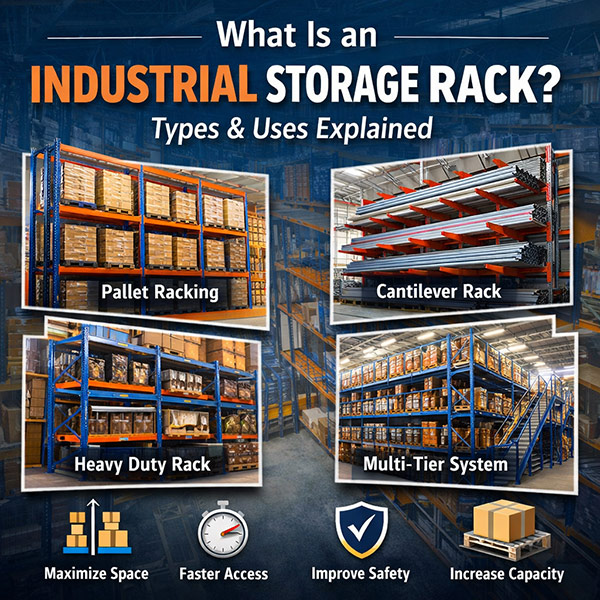
Pallet Racking System
This is the most common type found in warehouses today. It is designed specifically to hold wooden or plastic pallets. Forklifts lift the pallets and place them directly onto the horizontal beams of the rack.
- Where it is used: General warehouses and big-box retail stores.
- Advantages: Very easy to access every pallet and easy to install.
- Suitable Industries: Logistics, food and beverage, and consumer goods.
Cantilever Storage Rack
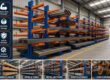
Unlike other racks, cantilever systems do not have front vertical posts. Instead, they have long arms extending from a central column. This makes them look like a series of “L” shapes.
- Where it is used: To store long, bulky, or oddly shaped items.
- Advantages: No front uprights get in the way of long items like pipes or lumber.
- Suitable Industries: Construction, plumbing, and timber yards.
Slotted Angle Rack
These are lighter-duty racks made of steel angles with holes punched at regular intervals. They are like a giant “Erector Set” for adults.
- Where it is used: Small storerooms or workshops.
- Advantages: Highly customizable and can be bolted together in any shape.
- Suitable Industries: Small retail shops, libraries, and pharmaceutical stores.
Heavy Duty Storage Rack
These are the “bodybuilders” of the racking world. They are built with thicker steel and reinforced beams to handle the heaviest possible loads.
- Where it is used: For storing raw steel, machinery parts, or engines.
- Advantages: Incredible strength and safety for massive weights.
- Suitable Industries: Manufacturing, mining, and heavy machinery.
Long Span Shelving Rack
This type bridges the gap between light shelving and heavy pallet racking. It is meant for items that are too heavy for a standard shelf but don’t require a forklift.
- Where it is used: For manual hand-loading of medium-sized boxes.
- Advantages: Provides a wide, clear space for large cartons.
- Suitable Industries: E-commerce warehouses and automotive parts distribution.
Multi-Tier Racking System
If a warehouse has a very high ceiling, a multi-tier system creates “floors” within the rack. It often includes walkways and stairs so workers can walk on the upper levels.
- Where it is used: For massive amounts of small items.
- Advantages: Effectively doubles or triples the usable floor area.
- Suitable Industries: Fashion/apparel and document storage.
Comparison Table of Industrial Storage Rack Types
| Rack Type | Storage Capacity | Suitable Industry | Key Benefit |
|---|---|---|---|
| Pallet Racking | High (Pallets) | Logistics & Retail | Easy forklift access |
| Cantilever Rack | Medium to High | Construction & Timber | Stores long items (pipes) |
| Slotted Angle | Light | Pharmacies & Offices | Cheap and adjustable |
| Heavy Duty | Very High | Manufacturing | Supports extreme weight |
| Long Span | Medium | E-commerce | Good for hand-picking |
| Multi-Tier | Medium | Fashion & Archives | Maximizes height with floors |
Common Uses of Industrial Storage Rack Systems
The versatility of the industrial storage rack means it appears in almost every sector of the economy. Here is how different businesses use them:
- Manufacturing Factories: Factories use racks to store raw materials (like metal sheets or plastic pellets) before they are turned into products. They also use them to store finished goods waiting to be shipped.
- Logistics Warehouses: These are the hubs where goods are sorted. Racks allow these centers to hold thousands of different products from various brands in one organized space.
- Retail Storage Centers: Stores like grocery chains or home improvement centers use racks in the “back room” to keep extra stock so the shelves out front never go empty.
- E-commerce Warehouses: Online shopping depends on speed. Racks are organized so that “pickers” can find your order and get it to the shipping dock in minutes.
- Automotive Spare Parts Warehouses: With thousands of different tiny bolts, belts, and large engines, these warehouses use a mix of racking types to keep everything categorized.
Benefits of Using Industrial Storage Rack in Warehouses
Investing in a high-quality industrial storage rack provides several immediate advantages to any business operation:
How to Select the Right Industrial Storage Rack
Choosing the wrong rack can be a costly—and dangerous—mistake. When selecting an industrial storage rack, consider these five factors:
- Warehouse Size: Measure your ceiling height. There is no point in buying a 20-foot rack if your ceiling is only 15 feet high. Also, leave enough room for your lights and sprinkler systems.
- Load Weight: How much do your products weigh? Always choose a rack that can hold more than your heaviest item to ensure a safety margin.
- Storage Requirements: Do you have “First-In, First-Out” (FIFO) needs? Some racks are designed so the oldest stock gets used first (like food), while others are for long-term storage.
- Accessibility Needs: Do you need to get to every pallet every day? If so, Selective Pallet Racking is best. If you only need certain items once a month, “Drive-In” racking might be better.
- Warehouse Equipment Compatibility: Make sure your forklift can actually reach the top shelf of the rack you choose. Also, ensure the aisles between racks are wide enough for the forklift to turn.
FAQ: Frequently Asked Questions
What is an industrial storage rack?
An industrial storage rack is a heavy-duty metal shelving system designed to store goods, materials, and pallets in warehouses and factories. It helps maximize vertical space and improve organization.
What are the different types of industrial storage racks?
Common types include Pallet Racks, Cantilever Racks (for long items), Slotted Angle Racks (for light use), and Multi-Tier Racks (which add extra floor levels).
Where are industrial racks used?
They are used in manufacturing plants, logistics centers, e-commerce warehouses, retail backrooms, and automotive repair shops.
What are the benefits of industrial storage racks?
The main benefits are saving floor space, keeping workers safe, protecting products from damage, and making it much faster to find and move inventory.
How much weight can storage racks hold?
It depends on the design. Light-duty racks might hold 100 kg, while heavy-duty industrial racks can hold over 5,000 kg per level. Always check the manufacturer’s weight rating.
Which rack is best for my warehouse?
For standard pallets, a Selective Pallet Rack is usually best. If you store long items like lumber, a Cantilever Rack is the right choice. If you have many small items and people picking by hand, choose Long Span Shelving.
Conclusion
In the fast-paced world of modern business, the industrial storage rack is much more than just a piece of metal furniture. It is a vital tool that allows companies to grow, stay organized, and keep their workers safe. By understanding the different types—from pallet racks to cantilever systems—businesses can choose the right setup to maximize their space and speed up their operations.
Whether you are starting a small warehouse or managing a massive distribution center, picking the right racking system is the first step toward success. It turns a cluttered floor into a streamlined, professional environment where every item has its place and every inch of space is used to its full potential.